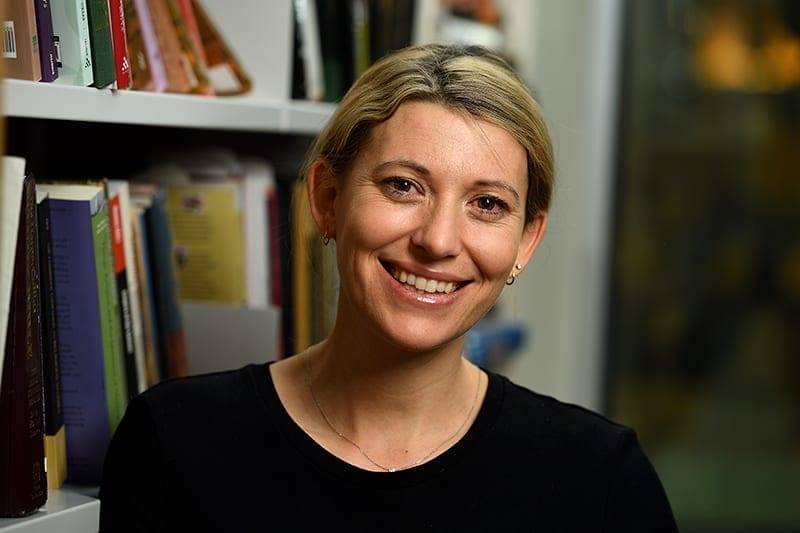
Alice Mandell
William Foxwell Albright Chair in Biblical and Ancient Near Eastern Studies; Director of Graduate Studies; Assistant Professor
Contact Information
- [email protected]
- Gilman 140
- 410-516-4701
Research Interests: Hebrew Bible; Northwest Semitics; ancient Near Eastern history and religion; Sociolinguistic approaches to writing
Education: PhD, University of California, Los Angeles
Alice Mandell was trained in the study of the Hebrew Bible and Northwest Semitics by UCLA’s Department of Near Eastern Languages and Cultures. From 2016–2018, Alice was an Assistant Professor in the Department of Classical and Ancient Near Eastern Studies at the University of Wisconsin–Madison.
In 2018, Alice joined the NES Department at Johns Hopkins University, where she is currently an Assistant Professor and the William Foxwell Albright Chair of Biblical and Ancient Near Eastern Studies. She is also a member of JHU's Jewish Studies program. At JHU, Alice teaches courses in biblical literature, Northwest Semitics, and the history and religion of the ancient Levant. She also teaches and researches sociolinguistic approaches to the study of writing.
Alice's research focuses on ancient Levantine scripts, written languages, and texts, spanning the second and first millennia BCE. Alice’s book, Canaanite Scribal Creativity and the Making of Cuneiform Culture in the Amarna Age (The Ancient World Series, edited by Seth L. Sanders [London: Routledge, 2026]), analyzes scribal practices in the Canaanite Amarna Letters using sociolinguistic theory and the multimodality perspective. Canaanite Scribal Creativity offers a critical apparatus of a selection of the Canaanite Amarna Letters, including an in-depth discussion of the scribe's visual, material, linguistic, and rhetorical strategies to communicate to Egypt on behalf of Levantine elites. This work argues against a prevalent view in scholarship that Canaanite cuneiform scribes were impoverished scribes and/or ineffectual communicators with the Egyptian court. Rather, Canaanite Scribal Creativity ascribes agency and ingenuity to the scribes behind the letters. It demonstrates that the Canaanite Letters are sociolinguistically and rhetorically complex works that were crafted by scribes for scribes. This book is available in print and open access (thanks to a Johns Hopkins University Libraries Open Monograph Initiative [JHLOMI] Open Access Award).
Alice's second book, The Amarna Letters and the Scribes Who Wrote Them (Element in the Ancient Near Eastern World and the Bible Series, edited by Christopher B. Hays and Brent A. Strawn [Cambridge: Cambridge University Press, in press]), highlights the important roles that cuneiform specialists played in Late Bronze Age diplomacy. Such scribes were letter writers who mediated between royal families and their officials, yet they were also active participants in the crafting of the political histories of the relationships between royal families.
Alice also has several ongoing projects that examine alphabet-based literacy practices in the ancient Levant. From 2020 to 2021, she was awarded a Getty Research Institute grant for research on the early alphabet. This work laid the foundation for her “craft-literacy” approach (Maarav 2023). She has published several articles that examine the literacy practices involved in text-making in craft production (e.g., JBL 2022). Her second book project, Alphabetic Word Craft: Levantine Craft Communities and Their Literacies, examines the evidence for the literacy practices involved in object making in the second and early first millennia BCE. This project has won two awards: a Johns Hopkins University Catalyst Award and a National Endowment for the Humanities award. In 2025, the Society for Textual Scholarship awarded Alice the Fredson Bowers Memorial Prize for Best Essay in Textual Scholarship for her 2023 Maarav essay: “Word Craft in the Ancient Levant: Craft-Literacy at the Intersection of Specialized Knowledge.”
In addition, Alice has several ongoing writing projects that extend to the use of writing in the southern Levant in contexts of ritual and performance. She is working with Jeremy D. Smoak (UCLA) on two books that apply theoretical approaches from the study of religion in the Iron Age Levant. The first book, Inscribing the Spaces of the Dead in Ancient Judah: An Introduction to Writing and Ritual Space, considers the multimodality and socio-spatial setting of tomb texts. They are also working on a book that will introduce a more general audience to recent work on materiality and spatial theory in the study of Israelite religion. Once these works are all in press, she will complete a commentary on 1–2 Kings for Cambridge.
Watch a recorded lecture featuring Alice Mandell on YouTube. The theme is The Bible in Assyriology, Past and Present. The video features Jeffrey L. Cooley (Boston College), Peter Machinist (Harvard University), Alice Mandell (The Johns Hopkins University), Gina Konstantopoulos (University of California Los Angeles), Abraham Winitzer (University of Notre Dame), Beate Pongratz-Leisten (New York University).
In this recorded lecture, Alice Mandell lectures on “Cuneiform Culture in the Amarna Period: A View from Canaan” for the Department of Classics and Ancient Mediterranean Studies at Penn State.